The information below contains selected facts which commonly appear in examinations:
| Nerve | Motor | Sensory | Typical mechanism of injury & notes |
|---|---|---|---|
| Musculocutaneous nerve (C5-C7) | Elbow flexion (supplies biceps brachii) and supination | Lateral part of the forearm | Isolated injury rare - usually injured as part of brachial plexus injury |
| Axillary nerve (C5,C6) | Shoulder abduction (deltoid muscle) | Inferior region of the deltoid muscle | Humeral neck fracture/dislocation Results in flattened deltoid |
| Radial nerve (C5-C8) | Extension (forearm, wrist, fingers, thumb) | Small area between the dorsal aspect of the 1st and 2nd metacarpals | Humeral midshaft fracture |
| Palsy results in wrist drop | |||
| Median nerve (C6, C8, T1) | LOAF* muscles | ||
| Features depend on the site of the lesion: | |||
| • wrist: paralysis of thenar muscles, opponens pollicis | |||
| • elbow: loss of pronation of forearm and weak wrist flexion | Palmar aspect of lateral 3½ fingers | Wrist lesion → carpal tunnel syndrome | |
| Ulnar nerve (C8, T1) | Intrinsic hand muscles except LOAF*Wrist flexion | Medial 1½ fingers | Medial epicondyle fracture |
| Damage may result in a 'claw hand' | |||
| Long thoracic nerve (C5-C7) | Serratus anterior | Often during sport e.g. following a blow to the ribs. Also possible complication of mastectomy | |
| Damage results in a winged scapula |
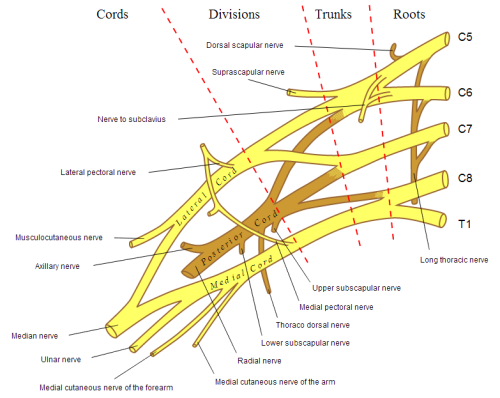
Diagram of the brachial plexus
Erb-Duchenne palsy ('waiter's tip')
Klumpke injury
^LOAF muscles