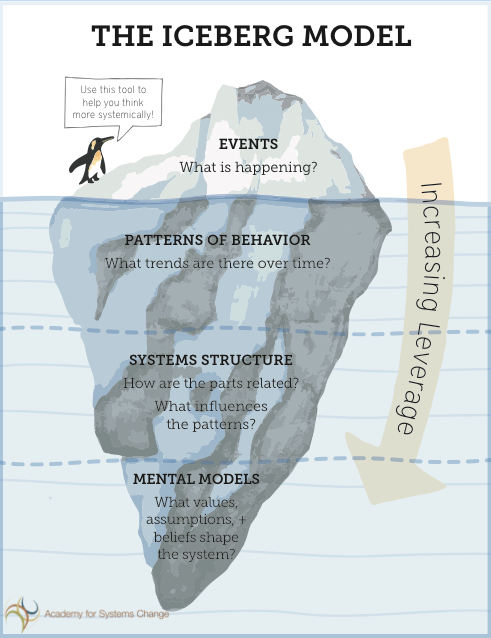
Systems thinking is essentially a study and harnessing of cause and effect over a wide range of space and time, factoring in a wide range of actors. In applying systems thinking to our lives, we must leverage at least three reflection disciplines:
1 - Self Reflection
2 - Environmental Reflection
3 - Relationship Reflection
We must examine the patterns in our lives on a regular basis. What do you see repeatedly happening in your life?
We must pay close attention to patterns because they have a huge impact on who we are and what we become in life.
The iceberg model is a valuable tool to encourage systemic thinking and help you contextualize an issue as part of a whole system. By asking you to connect an event–a single incident or occurrence–to patterns of behavior, systems structures, and mental models, the iceberg allows you to see the structures underlying the event. Just like an iceberg, 90% of which is invisible beneath the water, these structures are often hidden below the surface. However, if you can identify them and connect them to the events that you are seeing, you may be able to develop lasting solutions that target the whole system rather than short term, reactive solutions.
This simple theorem is easily visualized by imagining a bathtub: water enters the tub via the faucet and it exits through the drain, through leaks, or by overflowing the sides. These two flows of water–the inflow and the outflow–together determine the water level and stability of the bathtub. To maintain a constant level, the inflow must equal the outflow.
The bathtub theorem is a useful mental model when thinking about issues like economics and climate change. This simulation from Climate Interactive is an excellent way to familiarize yourself with the theorem while simultaneously learning about the relationship between carbon emissions and atmospheric carbon dioxide levels.

These diagrams are an important way to visualize and understand how a system of different elements is working together. As Donella Meadows wrote in Thinking in Systems,”If you understand the dynamics (behavior over time) of stocks and flows, you understand a good deal about the behavior of complex systems.” In describing stocks and flows, Donella Meadows stated, “A system stock is just what it sounds like: a store, a quantity of material or information that has built up over time. It may be a population, an inventory, the wood in a tree, the water in a well, the money in a bank…Stocks change over time through the actions of flows, usually actual physical flows into or out of a stock–filling, draining, births, deaths, production, consumption, growth, decay, spending, saving. Stocks, then, are accumulations, or integrals, of flows.”
Below is a more complex example of a stock and flow diagram that illustrates the volume of living wood in a forest. For more information on stocks and flows and this diagram, read this excerpt from Thinking in Systems.