AI index_report_2025- Stanford.pdf
PUBLIC AI DATA FILES- https://drive.google.com/drive/folders/1AxxxL9-AsaeMdDKtTNHCR1KqEJTsHCod
At Stanford HAI, we believe AI is poised to be the most transformative technology of the 21st century. But its benefits won’t be evenly distributed unless we guide its development thoughtfully. The AI Index offers one of the most comprehensive, data-driven views of artificial intelligence. Recognized as a trusted resource by global media, governments, and leading companies, the AI Index equips policymakers, business leaders, and the public with rigorous, objective insights into AI’s technical progress, economic influence, and societal impact.
https://www.youtube.com/embed/ABxQBIBsBHY
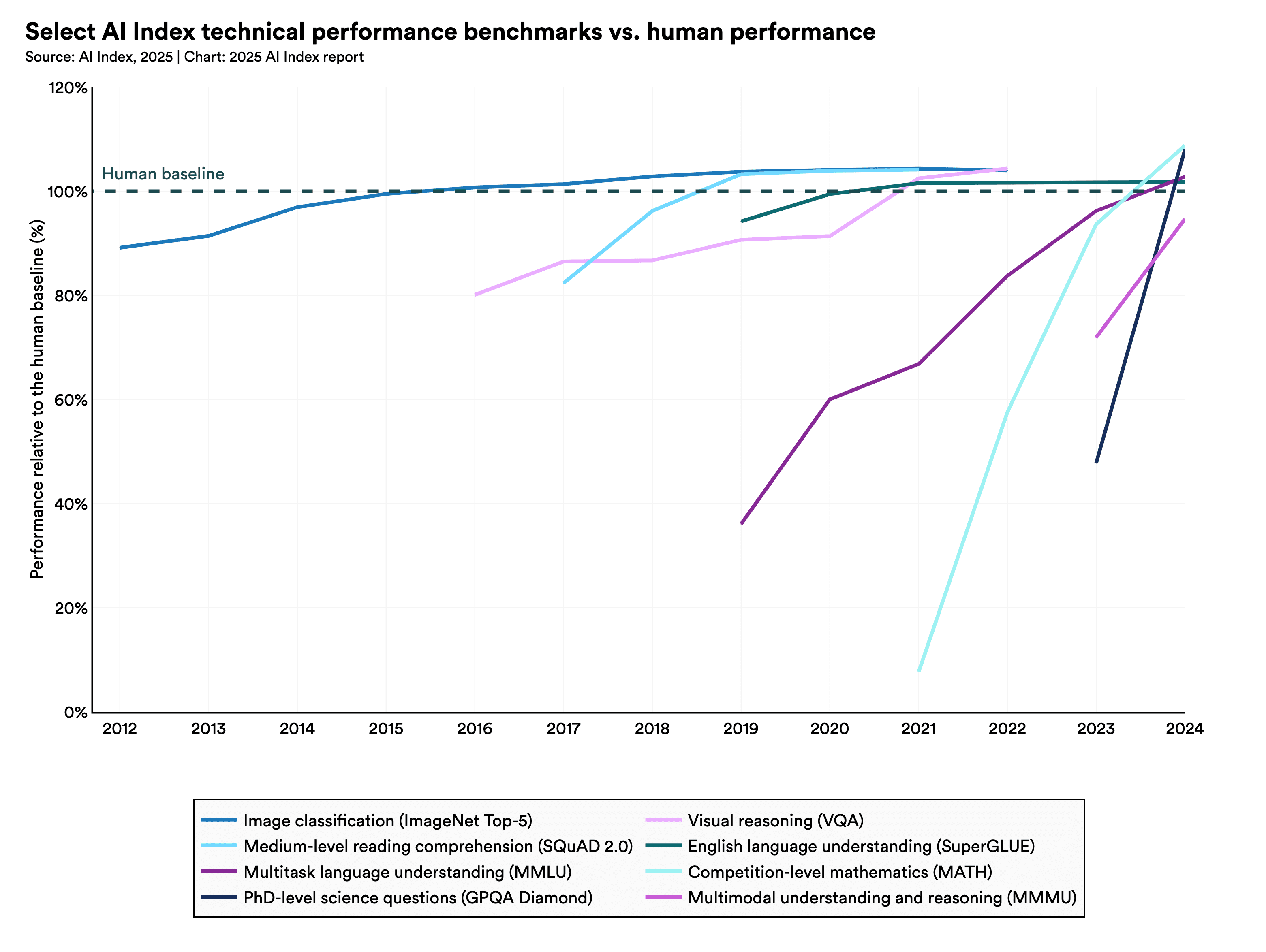
In 2023, researchers introduced new benchmarks—MMMU, GPQA, and SWE-bench—to test the limits of advanced AI systems. Just a year later, performance sharply increased: scores rose by 18.8, 48.9, and 67.3 percentage points on MMMU, GPQA, and SWE-bench, respectively. Beyond benchmarks, AI systems made major strides in generating high-quality video, and in some settings, language model agents even outperformed humans in programming tasks with limited time budgets.
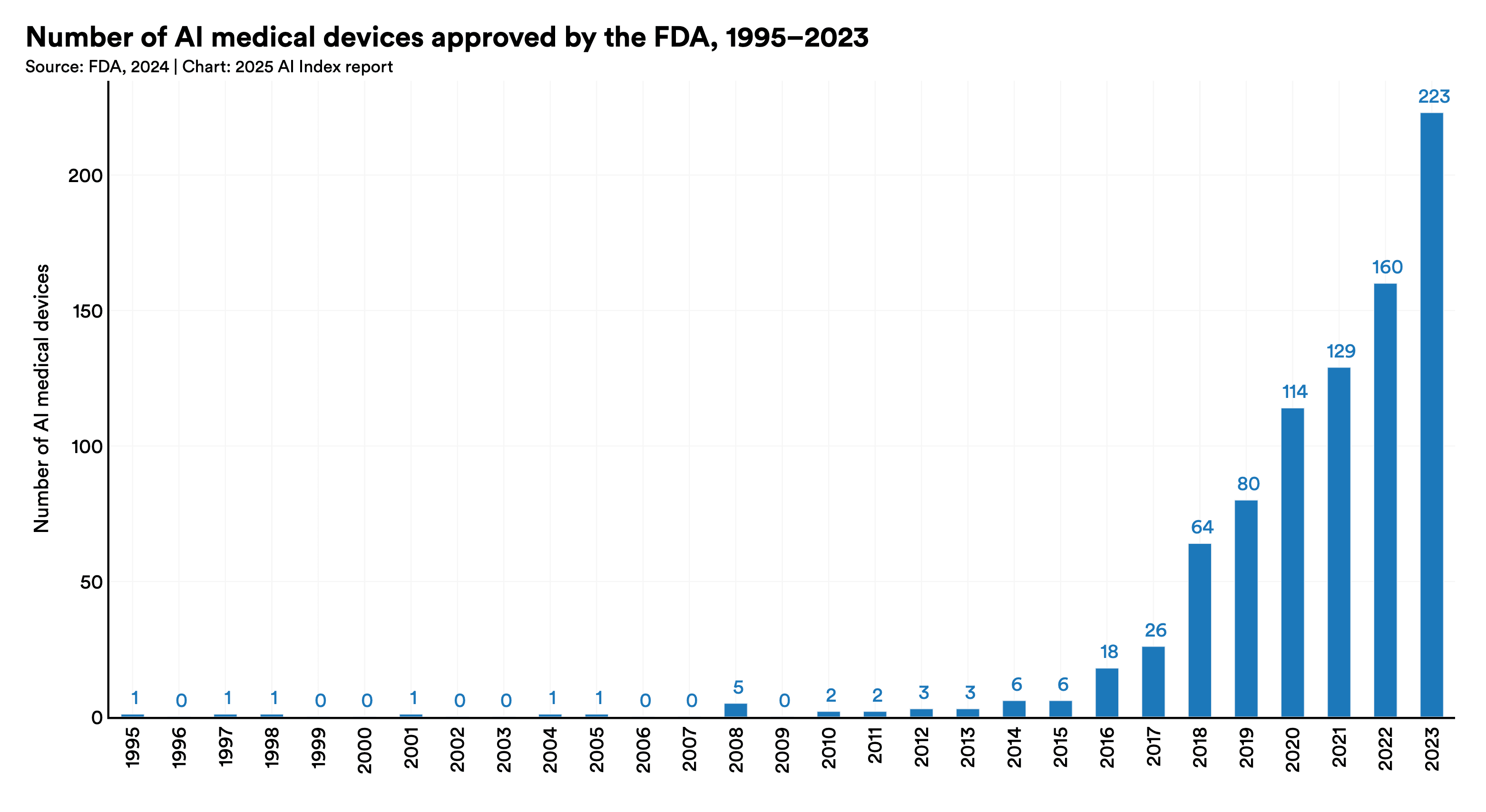
From healthcare to transportation, AI is rapidly moving from the lab to daily life. In 2023, the FDA approved 223 AI-enabled medical devices, up from just six in 2015. On the roads, self-driving cars are no longer experimental: Waymo, one of the largest U.S. operators, provides over 150,000 autonomous rides each week, while Baidu’s affordable Apollo Go robotaxi fleet now serves numerous cities across China.
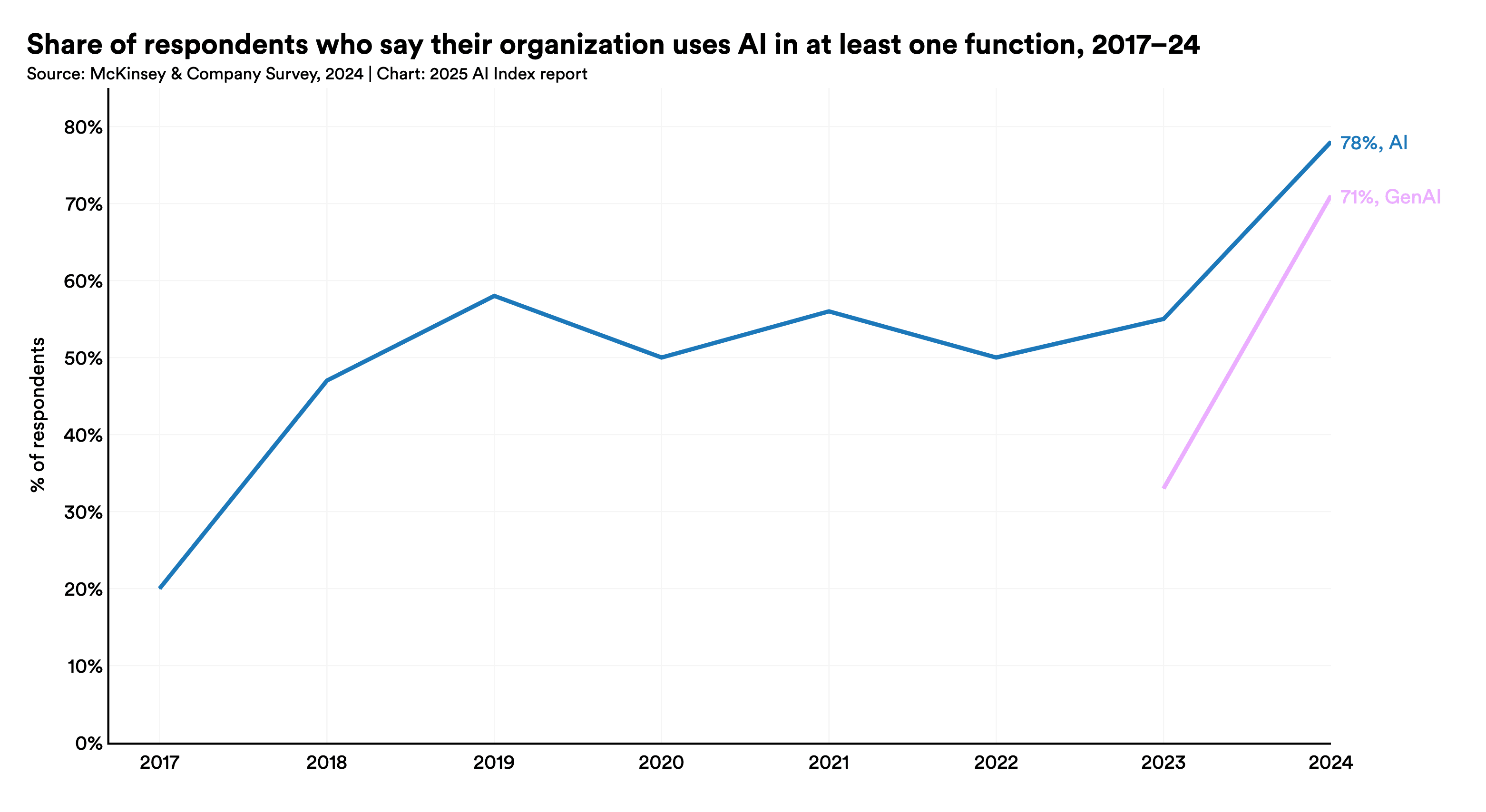
In 2024, U.S. private AI investment grew to $109.1 billion—nearly 12 times China’s $9.3 billion and 24 times the U.K.’s $4.5 billion. Generative AI saw particularly strong momentum, attracting $33.9 billion globally in private investment—an 18.7% increase from 2023. AI business usage is also accelerating: 78% of organizations reported using AI in 2024, up from 55% the year before. Meanwhile, a growing body of research confirms that AI boosts productivity and, in most cases, helps narrow skill gaps across the workforce.