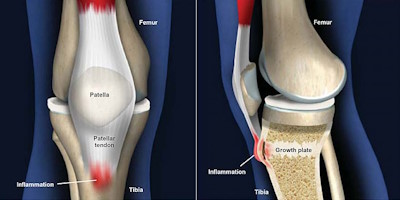
The table below summarises the key features of common knee problems:
| Condition | Key features |
|---|---|
| Chondromalacia patellae | Softening of the cartilage of the patella |
| Common in teenage girls | |
| Characteristically anterior knee pain on walking up and down stairs (usually described as “a grinding sensation or clicking sound” within the knee joint) and rising from prolonged sitting (often associated with quadriceps muscle weakness) | |
| Usually responds to physiotherapy | |
| Osgood-Schlatter disease(tibial apophysitis) | Seen in sporty teenagers |
| Pain, tenderness and swelling over the tibial tubercle | |
| Osteochondritis dissecans | Pain after exercise |
| Intermittent swelling and locking | |
| Patellar subluxation | Medial knee pain due to lateral subluxation of the patella |
| Knee may give way | |
| Patellar tendonitis | More common in athletic teenage boys |
| Chronic anterior knee pain that worsens after running | |
| Tender below the patella on examination |
Referred pain may come from hip problems such as slipped upper femoral epiphysis
The table below summarises the key features of common knee problems:
| Condition | Key features |
|---|---|
| Osteoarthritis of the knee | Patient is typically > 50 years, often overweight |
| Pain may be severe | |
| Intermittent swelling, crepitus and limitation of movement may occur | |
| Infrapatellar bursitis (Clergyman's knee) | Associated with kneeling |
| Prepatellar bursitis (Housemaid's knee) | Associated with more upright kneeling |
| Anterior cruciate ligament | May be caused by twisting of the knee - 'popping' noise may have been noted |
| Rapid onset of knee effusion | |
| Positive draw test | |
| Posterior cruciate ligament | May be caused by anterior force applied to the proximal tibia (e.g. knee hitting dashboard during car accident) |
| Collateral ligament | Tenderness over the affected ligamentKnee effusion may be seen |
| Meniscal lesion | May be caused by twisting of the kneeLocking and giving-way are common featureTender joint line |
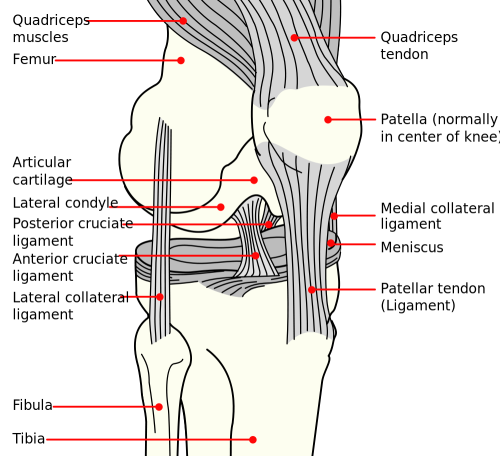
Iliotibial band syndrome is a common cause of lateral knee pain in runners, occurring in around 1 in 10 people who run regularly.
Features tenderness 2-3cm above the lateral joint line
Management activity modification and iliotibial band stretches if not improving then physiotherapy referral