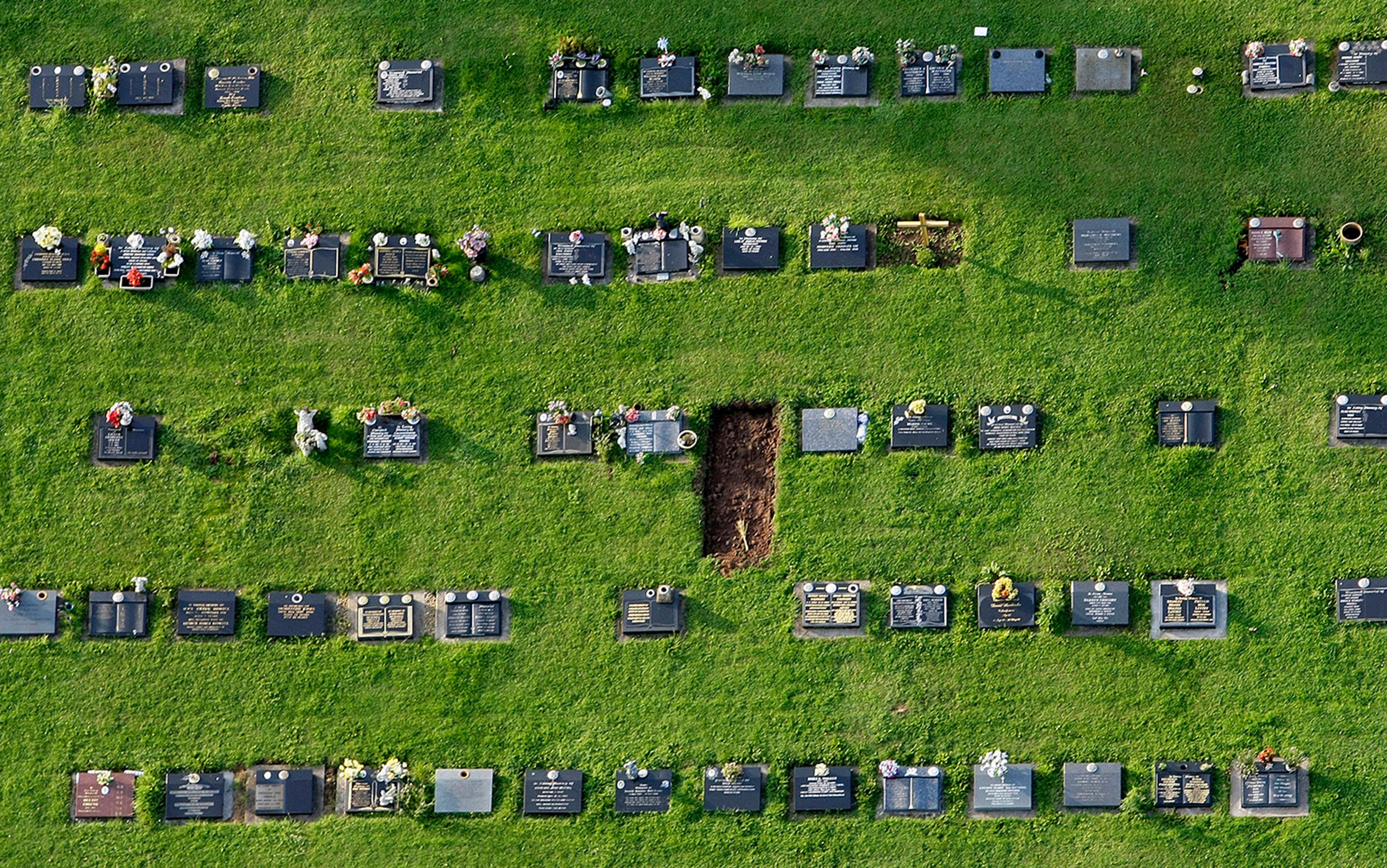
A cemetery in Bristol, England, seen from a hot air balloon flight in August 2009. Photo by Stefan Wermuth/Reuters
Jeff Greenberg is a professor and social psychology programme director at the University of Arizona. His books include The Worm at the Core: On the Role of Life in Death (2015), co-authored with Sheldon Solomon and Tom Pyszczynski. Edited bySam Dresser3,800 wordsListen here Brought to you by Curio, an Aeon partner Listen to more Aeon Essays hereSyndicate this essayEmailSavePost
Many people think consciously about their mortality only once in a blue moon. Maybe if an odd mole appears. Or after a close call in the car. Or when they read about the death of a celebrity their age. Maybe it’s in the middle of the night, when they can’t get back to sleep and the reality of their inevitable ending sinks in. I, on the other hand, have been thinking about my own mortality, and indeed everyone’s, most of my professional career. You might guess that I’m a mortician, or a coroner, or maybe an oncologist. But actually, I’m a social psychologist and my focus has been on trying to understand human social behaviour. What does mortality have to do with understanding human behaviour? More than most of us think.
I spent my early childhood in a working-class Italian neighbourhood in the South Bronx in New York City. Many African-American families were then moving into the area. At the time, I remember having two observations about people that bugged me: their pride and their prejudice. Everyone around me seemed to think they were right about everything – smarter and more moral than anyone else. And the people in my neighbourhood seemed to have something against those who had darker skin than they did. I thought about these tendencies occasionally, though they didn’t seem to concern people around me. Then, in 12th grade, I was assigned Jonathan Swift’s literary satire Gulliver’s Travels (1726), and I was shocked to find that here, finally, was someone who saw humans the way I did. And someone who died back in 1745 at that.
This renewed my interest in these human proclivities, and so I decided to major in psychology as an undergrad at the University of Pennsylvania to learn more. Then I went to grad school in social psychology at the University of Kansas and, with my fellow students Sheldon Solomon and Tom Pyszczynski, I began studying people’s prejudices, and their ways of protecting their pride, their self-esteem. We learned that people engage in all sorts of mental gymnastics in order to feel good about themselves and their group. People who don’t succeed in doing so function poorly and experience anxiety and depression. But our studies left us with no answers as to why people are so invested in self-esteem and the superiority of their own group. It seemed to just be taken as a given.
So we looked outside our field and discovered the works of the American cultural anthropologist Ernest Becker (1924-74). He gave us some answers in his book The Denial of Death (1973), which won the Pulitzer Prize for nonfiction in 1974, and counts Bill Clinton and Woody Allen among its many fans. Becker takes the reader to a familiar, yet rarely visited place – where one is faced with what being mortal really means: ‘Man … is a symbolic self, a creature with a name, a life history,’ Becker wrote, ‘and yet he goes back into the ground a few feet in order blindly and dumbly to rot and disappear forever.’
His book forces us to really consider our own inevitable death, consciously, in a way we might not have since that fact first dawned on us. It’s not a fun read. But from this consideration of mortality, Becker builds a case for the fear of death as a pervasive influence on human behaviour. He argues that we all fear death and we would be perpetually terrified if we didn’t have a way to deny, escape or transcend it. The ancient philosophers Epicurus and Lucretius recognised the role of the fear of death in human endeavours. But they argued that we would lead better lives if we realised that it’s not logical to fear death because, if it is the end, then it will be nothing. We don’t fear not existing before we were born, so why should we fear not existing after we are dead?
The problem is that we are not logical beings. We are animals. And, like other animal species, we are biologically predisposed in many ways to continue living. If someone tries to suffocate you with a pillow, you struggle to breathe. If a car comes toward you, you dive out of the way. Becker used the example of people on a commercial airliner. If there is a sudden loud noise or the plane begins a sudden descent, everyone onboard feels terror and panic. So we have in our limbic system a fear of death and desire to avert it at all costs. As do, probably, many species of animals.
Literal and symbolic immortality are fundamental bases of our psychological security
But what’s different about us humans is that we also have a cerebral cortex with frontal lobes that allows us to realise that death could come at any time for a wide range of reasons that we can neither predict nor control. And furthermore, it’s going to happen, sooner or later. So how are we able to function with equanimity knowing this, instead of cowering in a corner paralysed by terror? Becker proposed that, as our ancestors became aware of the predicament of being mortal, they developed cultural worldviews that could allow them to believe that death is not the end of our existence, that in some way they will continue beyond their physical deaths, and the worldviews that have evolved since then have continued to promote this view.
The most obvious way that worldviews provide this hope is through belief in an immortal soul that lives on after our body dies. The oldest burial sites and ancient artifacts suggest such a belief in an afterlife goes back more than 50,000 years. We call that ‘literal immortality’. The other major way is through a sense that the symbols of us – the things that represent us – will continue on after our physical deaths: our nation, our offspring, our contributions to the world through teaching, art, science and the causes we identify with. We call this ‘symbolic immortality’. The first known written story, The Epic of Gilgamesh, attests to how central these concerns have been to our species. Gilgamesh becomes obsessed with death and how to avert it. He first tries to appease the gods for immortality, then he tries to find a plant that will let him never die, and finally settles for symbolic immortality by being remembered for doing great deeds and building great monuments – and he actually achieved that through the tablets that conveyed his story.
Literal and symbolic immortality are fundamental bases of our psychological security, but they depend on two things. First, we must maintain faith in a culturally based view of the world that provides a basis for believing in the possibilities of literal and/or symbolic immortality. Second, we must believe that we are valued contributors to this world so that we qualify for these forms of transcending our physical deaths. I call these two components of effective terror management. People live out their lives largely imbedded in a symbolic world of meaning and value in which they can believe they are of enduring significance and, as long as they maintain belief in that world and their significance, they can function with psychological equanimity. However, if either of these beliefs is threatened, defences must be marshalled or death anxiety will percolate to the surface.
How, then, do these ideas inform pride and prejudice? From the perspective of this terror management theory, the problems of prejudice and intergroup conflict arise because groups that have a worldview different from one’s own are explicitly or implicitly suggesting that our own basis for feeling psychologically secure is wrong. To alleviate that threat, we must either derogate those others as stupid or evil, try to convince them that ours is the right worldview, or get rid of them. How many times over the course of history have we seen those impulses played out to great suffering and tragedy?
What about our pride? Striving for and defending one’s self-esteem are efforts to maintain the belief that one is a valued contributor to the world that our culture teaches us to believe in. As long as we believe we are significant contributors to this world, we have that sense of immortality and can function securely in the world. How do we come to be imbedded in these cultural belief systems and driven to be valued parts of them? This is a central function of the socialisation process, which Becker described beautifully in his book The Birth and Death of Meaning (1962).
The human newborn is one of the most helpless and dependent of all living creatures. Its survival and relief of distress depend on the love and protection of the parents. But as the child moves into toddlerhood, that love and protection become increasingly dependent on being a good little girl or boy. Be gentle with the cat, pee in the toilet. Over time, the child has to internalise a remarkable number of rules and values to stay in the good graces of the seemingly omnipotent parents, the only security base the small child has. So being good is the basis for feeling secure. And being bad is a precarious, scary thing, as it’s associated with possible loss of love and threat of punishment.
Being good is based on what is learned from the parents, which reflects the cultural worldview the parents themselves were taught. And so we strive for self-esteem because it tells us that we are good worthy people and therefore loved and protected. Of course, as we develop cognitively, we learn that there are threats too big for our parents, and that they are not omnipotent. But they have taught us bigger things in which we can believe, and therefore we shift our primary bases of security to our god, our nation, our family line, science, humanity. As adults, we still need that self-esteem, that sense of significance, to feel secure, but we get it by feeling like worthy contributors to those larger entities we have learned to believe in. Doing so allows us to feel that we will continue on, as valued Christians, artists, scientists, Australians, and so forth.
It’s a big theory, with psychoanalytic roots, that seems to account for a lot of human behaviour
Having been convinced by Becker that awareness of mortality plays a significant role in human behaviour, we formalised these ideas into terror management theory to introduce them into psychological science. We submitted a paper to the American Psychologist journal, explaining the theory and how it can account for so much we know from anthropology, archaeology, history, as well as psychology. Neither the editors nor the reviewers were pleased. One review was just a sentence long: ‘I have no doubt that this would be of no interest to any psychologist, living or dead.’ (You’d think at least dead ones would be interested!)
Such comments gave no clues on what the reviewers disliked, but our guess was that their reactions were due to two aspects of the theory: first, that it concerns a scary topic, the inevitability of death; and second, that it’s a big theory, with psychoanalytic roots, that seems to help account for a lot of aspects of human behaviour. Ever since the reaction against Sigmund Freud in the 1950s, academic psychologists have been suspicious of big theories, accusing them of being unfalsifiable, or unscientific. After parrying with the journal about the lack of legitimate critiques of the paper, one beleaguered editor was kind enough to actually engage by telling us that, although these ideas might have merit, we would have to gather new evidence for them to attain ‘valid currency’ in the field.