
“What is essential is invisible to the eye,” Antoine de Saint-Exupéry memorably wrote in The Little Prince. Indeed, in our quest to perfect thinking, could we be neglecting those deeper, more intuitive gateways to accessing the essential? Susan Sontag memorably argued that the false polarity of intuition vs. intellect imprisons us, but the question remains — how do we really know what we know? By what mechanism can we truly make sense of the world and our place in it?
A decade after his influential clarion call for prioritizing people over goods and creativity over consumption, British economic theorist and philosopher E.F. Schumacher turned to this delicate subject in his 1977 essay collection A Guide for the Perplexed (public library) — not to be confused with this Werner Herzog gem of the same title — in which Schumacher also explored how to map the meaning of life.
Schumacher considers the concept of adaequatio:
What enables man to know anything at all about the world around him? … Nothing can be known without there being an appropriate “instrument” in the makeup of the knower. This is the Great Truth of “adaequatio” (adequateness), which defines knowledge as adaequatio rei et intellectus — the understanding of the knower must be adequate to the thing to be known.
Building upon his notion of the five Levels of Being, Schumacher bridges the physical and the metaphysical:
Our five bodily senses make us adequate to the lowest Level of Being — inanimate matter. But they can supply nothing more than masses of sense data, to “make sense” of which we require abilities or capacities of a different order. We may call them “intellectual senses.” Without them we should be unable to recognize form, pattern, regularity, harmony, rhythm, and meaning, not to mention life, consciousness, and self-awareness. While the bodily senses may be described as relatively passive, mere receivers of whatever happens to come along and to a large extent controlled by the mind, the intellectual senses are mind-in-action, and their keenness and reach are qualities of the mind itself.
Illustration by Vladimir Radunsky from On a Beam of Light: A Story of Albert Einstein by Jennifer Berne

He illustrates the spectrum of human ability as it relates to our capacity for adaequatio:
As regards the bodily senses, all healthy people possess a very similar endowment, but no one could possibly overlook the fact that there are significant differences in the power and reach of people’s minds… Beethoven’s musical abilities, even in deafness, were incomparably greater than mine, and the difference did not lie in the sense of hearing; it lay in the mind. Some people are incapable of grasping and appreciating a given piece of music, not because they are deaf but because of a lack of adaequatio in the mind. The music is grasped by intellectual powers which some people possess to such a degree that they can grasp, and retain in their memory, an entire symphony on one hearing or one reading of the score; while others are so weakly endowed that they cannot get it at all, no matter how often and how attentively they listen to it. For the former, the symphony is as real as it was for the composer; for the latter, there is no symphony: there is nothing but a succession of more or less agreeable but altogether meaningless noises. The former’s mind is adequate to the symphony; the latter’s mind is inadequate, and thus incapable of recognizing the existence of the symphony.
This spectrum plays out over and over in every domain of the human experience and, Schumacher argues, making sense of the world in an intelligent way requires that we understand where we fall on the spectrum of adaequatio in every domain of knowledge. Ignorant attitudes, he implies, result from assuming that something is not true or not valuable simply because we lack the adaequatio to grasp it:
For every one of us only those facts and phenomena “exist” for which we posses adaequatio, and as we are not entitled to assume that we are necessarily adequate to everything, at all times, and in whatever condition we may find ourselves, so we are not entitled to insist that something inaccessible to us has no existence at all and is nothing but a phantom of other people’s imaginations.
This pulls into question the notion of capital-T Truth as commonly used and pursued:
People say: “Let the facts speak for themselves”; they forget that the speech of facts is real only if it is heard and understood. It is thought to be an easy matter to distinguish between fact and theory, between perception and interpretation. In truth, it is extremely difficult.
In a sentiment that Philip K. Dick would echo mere months later in asserting that “reality is that which, when you stop believing in it, doesn’t go away,” Schumacher adds:
When the level of the knower is not adequate to the level (or grade of significance) of the object of knowledge, the result is not factual error but something much more serious: an inadequate and impoverished view of reality.
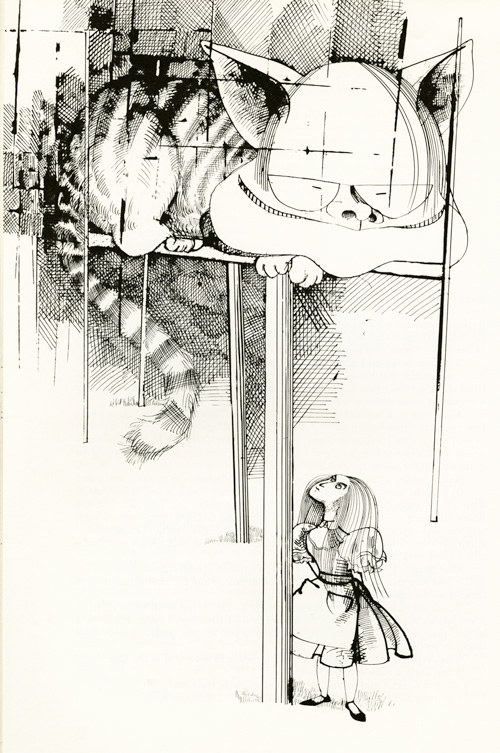
Illustration by Ralph Steadman for a rare edition of Alice in Wonderland.
But the most important determinants of our access to knowledge, Schumacher argues, are our direction of interest and our existing beliefs — something even truer today, not to mention more dangerous, in our age of filter bubbles, when we have an ever-harder time changing our minds. Schumacher writes: