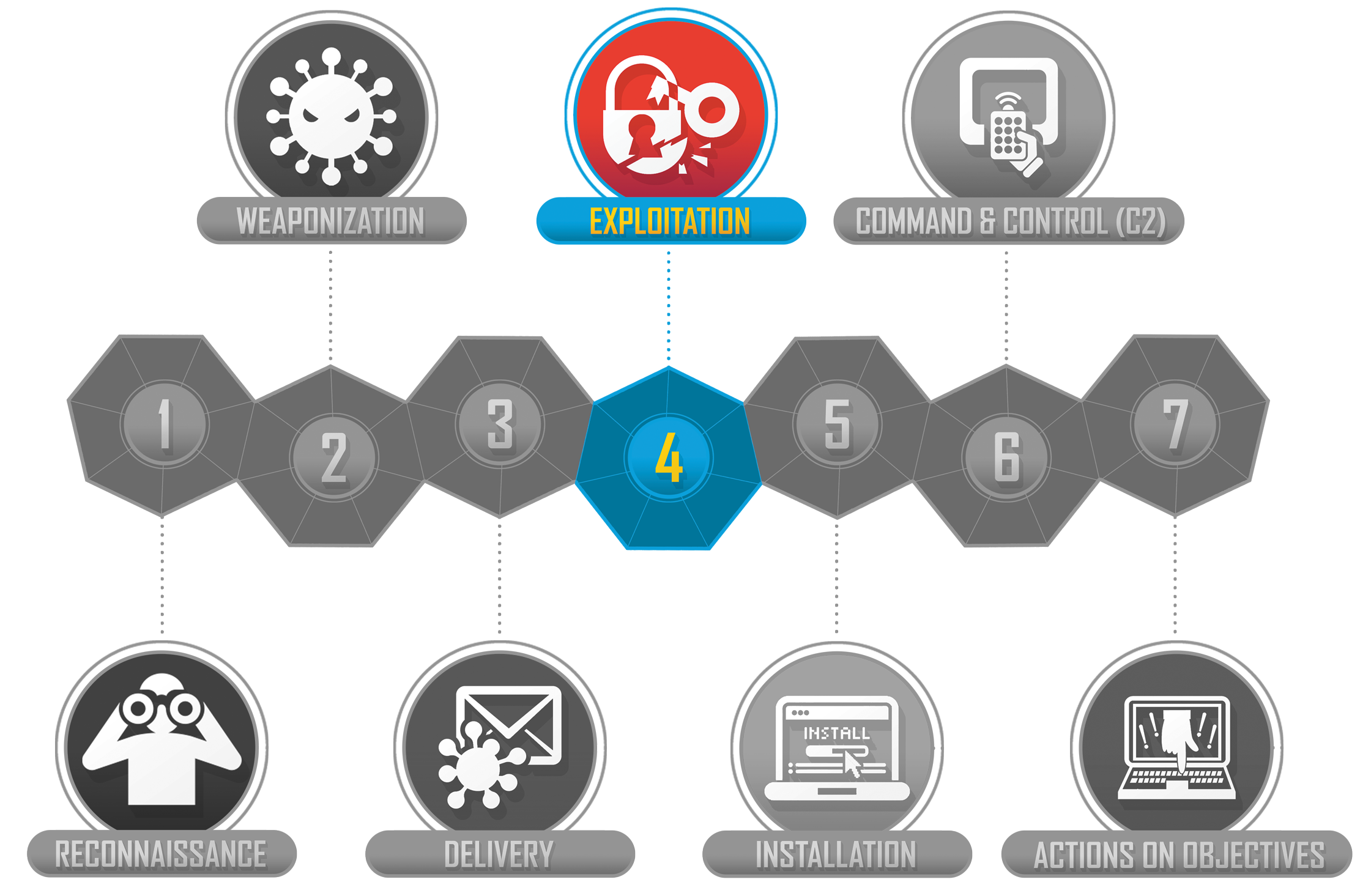
The fourth step of the Cyber Kill Chain is the "Exploitation" stage. The attacker ensures that the malicious content provided to the victim in the previous step gets activated in this stage. During the exploitation step, the process of running the malware transmitted to the victim's device is carried out. The initial operation in the system is performed by the attacker at this stage.The exploit operation performed here is a precursor of the attack activities that will be carried out in the subsequent phases. The next phases of the cyber attack cannot be carried out if the exploit fails here for a reason, or if the delivered malware cannot be run.
The attacker has some basic knowledge about the program or system intended to be exploited in the target and has prepared the appropriate attack tools beforehand in the "Exploitation" stage. This is the step the attacker's exploit or tool is run/tested. This step may be failed if the exploit or tool is not suitable to be utilized on the victim's system. At this level, the attacker can perform the following operations:
Defending against exploitation poses a significantly more intricate and labor-intensive task for Blueteams compared to other stages. This is primarily due to the potential encounter with previously unseen malware or exploits, which adds a layer of complexity to the defense process. To elucidate, the use of zeroday exploits can complicate the detection and prevention procedures during this phase. The following points may be considered to detect and prevent malicious activities:
The "Exploitation" phase, which is the fourth step in the Cyber Kill Chain, is covered in this section of the training, along with some activities that attackers can take in this step and some measures that Blueteams can perform at this stage. The "Installation" step is explained in the following section of the course.