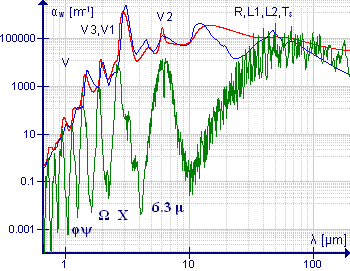
Absorption spectrum (attenuation coefficient vs. wavelength) of liquid water (red),[1][2][3] atmospheric water vapor (green)[4][5][6][4][7] and ice (blue line)[8][9][10] between 667 nm and 200 μm.[11] The plot for vapor is a transformation of data Synthetic spectrum for gas mixture 'Pure H2O' (296K, 1 atm) retrieved from Hitran on the Web Information System.[6]
Liquid water absorption spectrum across a wide wavelength range[missing source]

The absorption of electromagnetic radiation by water depends on the state of the water.
The absorption in the gas phase occurs in three regions of the spectrum. Rotational transitions are responsible for absorption in the microwave and far-infrared, vibrational transitions in the mid-infrared and near-infrared. Vibrational bands have rotational fine structure. Electronic transitions occur in the vacuum ultraviolet regions.
Its weak absorption in the visible spectrum results in the pale blue color of water.
[edit]
The water molecule, in the gaseous state, has three types of transition that can give rise to absorption of electromagnetic radiation:
Rotational transitions, in which the molecule gains a quantum of rotational energy. Atmospheric water vapour at ambient temperature and pressure gives rise to absorption in the far-infrared region of the spectrum, from about 200 cm (50 μm) to longer wavelengths towards the microwave region.
−1
Vibrational transitions in which a molecule gains a quantum of vibrational energy. The fundamental transitions give rise to absorption in the mid-infrared in the regions around 1650 cm (μ band, 6 μm) and 3500 cm (so-called X band, 2.9 μm)
−1
−1
Electronic transitions in which a molecule is promoted to an excited electronic state. The lowest energy transition of this type is in the vacuum ultraviolet region.
In reality, vibrations of molecules in the gaseous state are accompanied by rotational transitions, giving rise to a vibration-rotation spectrum. Furthermore, vibrational overtones and combination bands occur in the near-infrared region. The HITRAN spectroscopy database lists more than 37,000 spectral lines for gaseous H216O, ranging from the microwave region to the visible spectrum.[5][12]
In liquid water the rotational transitions are effectively quenched, but absorption bands are affected by hydrogen bonding. In crystalline ice the vibrational spectrum is also affected by hydrogen bonding and there are lattice vibrations causing absorption in the far-infrared. Electronic transitions of gaseous molecules will show both vibrational and rotational fine structure.
[edit]
Infrared absorption band positions may be given either in wavelength (usually in micrometers, μm) or wavenumber (usually in reciprocal centimeters, cm−1) scale.
[edit]