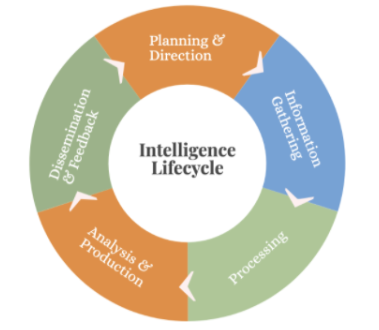
Planning and Direction
The planning and directing phase should be the foundation of a structure that must function flawlessly. Planning is the part that allows us to find answers to questions such as what exactly is expected from intelligence, who will consume the intelligence obtained, and which teams or individuals will take action as a result of the intelligence obtained. Intelligence will be used by executives or a team of analysts. You can directly feed your SOC team with the intelligence obtained and/or present summary reports to your managers. At this point, what you want is important. Your requests will also clarify the scope of the intelligence. For example, an organization can determine the scope of intelligence it wants to obtain by asking the following questions:
Does your organization have a SOC team?
This question shows us whether there is a technical team that will actively use the intelligence obtained, and if there is, it is an indication that shows us we can go down to the technical details of the intelligence. If there is not a SOC team it indicates that the intelligence will be consumed by managers. In this case, an intelligence model that offers clearer and more understandable summaries can be taken as a basis, without being bogged down in technical details.
Has your organization been attacked before? If so, what was the success rate of the attack?
The fact that the organization was exposed to a high rate of successful attacks can be used to reduce the success rate of future attacks by putting the intelligence on the basis of the established structure, and the intelligence obtained with the data collected from the current attacks. This tells us how often we will use intelligence in the organization. It controls how often we pull data from internal and external sources. It is important that the intelligence obtained is constantly updated and consumed quickly for frequently attacked organizations.
Do the attacks target organization or individuals?
It is important to focus on the External Attack Surface Management area, which the intelligence contains, to make the threat surface as clear as possible and to follow it up regularly for attacks targeting the organization. External Attack Surface Management is to determine and manage the attack surface of organizations. It will be covered in detail in the following sections. For attacks targeting individuals, the Digital Risk Protection part is crucial. Digital Risk Protection defines the digital risks that organizations may face through the attack surface. It will be covered in detail in the following sections. It reveals that we need to clarify certain issues such as users' login credentials, their risks to be exposed to phishing attacks, and defining the strength of your password policy.
Are other companies in your industry exposed to the same attacks you received?
This question explains the need for us to turn to industry-based intelligence that provides us with intelligence about other companies in our industry. When other companies are getting attacked, industry-based intelligence provides us with the IOC (Indicators used to identify attacks digitally, and threat actors) related to that specific attack, and also it will allow us to avoid that attack with minimum damage if we are exposed to the same attack.
Information Gathering
The information collection stage is the part where we determine what sources we will collect data from. These resources can be both internal and external. Some of the sources we will collect data from are as follows:
Processing
The data obtained is processed at this stage which may be considered a filter. We clean the data from false positives as much as possible, pass it through certain rule sets, and subject it to some correlations. At the end of this process, we get the information we need.
Analysis and Production
The information obtained is interpreted and analyzed at this stage and the consumable intelligence is obtained as a result of the output of the analysis. After this point, appropriate reports are to be prepared according to who will consume the intelligence.
Dissemination and Feedback
Dissemination of the intelligence appropriately is the next step for whom the intelligence is intended. For example, intelligence from external sources to the technical team should be distributed to other users in the organization through appropriate channels, and the necessary feedback should be given to make the intelligence better and more efficient at the end of the whole process. Let's say that content with the name of our organization is created through a site builder at the subdomain of letsdefend.blogspot.com. If the blogspot.com domain is marked as suspicious or harmful in the intelligence and not this subdomain, this will result in many false positives. In such cases, we need to improve the intelligence with feedback.