In this section, we will explain the basic concepts that you need to know about incident management. Since you will encounter these concepts frequently during your education and your daily work routine, we recommend that you understand these concepts thoroughly:
Alert
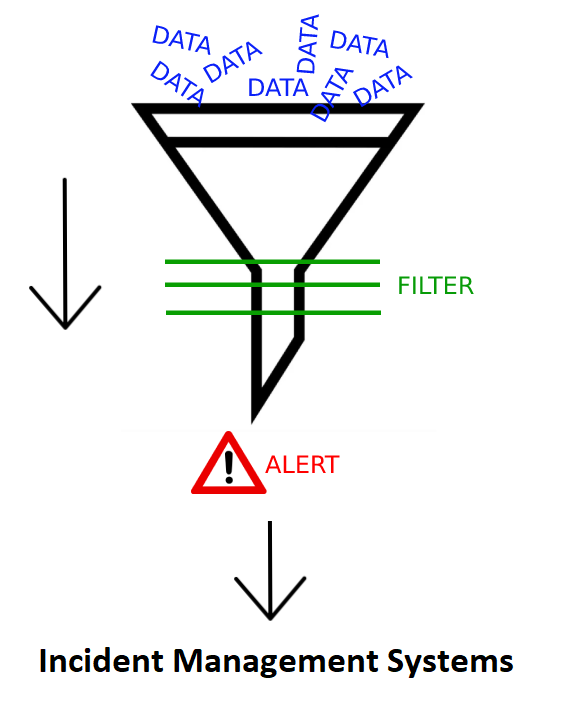
We talked about how an alert is created in the SIEM training module. You can click on the link (https://app.letsdefend.io/training/lessons/siem-101) to access the training. To briefly recall, an alert is generated as a result of data collection and processing (parsing, enriching, etc.) in SIEM, as seen in the image below. Then, we start the analysis process by sending the generated alarms to the Incident Management System.
Event
An event is any observable occurrence in a system or network. Simply, events are activities like a user connecting to a file share, a server receiving a request for a Web page, a user sending electronic mail (e-mail), a firewall blocking a connection attempt, etc.
Incident
The definition of a computer security incident has evolved over time. In the past, a computer security incident was thought of as a security-related adverse event in which there was a loss of data confidentiality, disruption of data or system integrity, or disruption or denial of availability.
A lot of new types of computer security incidents have emerged since then, and this necessitated an expanded definition of "incident". Generally, an incident is a violation or imminent threat of violation of computer security policies, acceptable use policies, or standard security practices. Definitions: NIST Special Publication 800-61
True Positive Alert
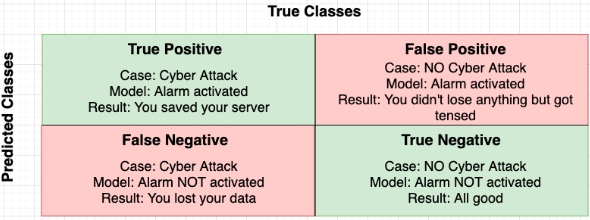
If the situation to be detected and the detected (triggered alert) situation are the same, it is a True Positive alert. For example, let's say you had a PCR test to find out whether you are Covid19 positive and the test result came back positive. It is True Positive because the condition you want to detect (whether you have Covid19 disease) and the detected condition (being a Covid19 patient) are the same. This is a true positive alert.
Let's suppose there is a rule to detect SQL Injection attacks and this rule has been triggered because of a request that was made to the following URL. The alert is indeed a "True Positive" as there was a real SQL Injection attack.
https://app.letsdefend.io/casemanagement/casedetail/115/src=' OR 1=1
False Positive Alert
In short, it is a false alarm. For example, there is a security camera in your house and if the camera alerts you due to your cat's movements, it is a false positive alert.
If we look at the URL example below, we see the SQL parameter "Union" keyword within this URL. If an SQL injection alert occurs for this URL, it will be a false positive alert because the "Union" keyword is used to mention a sports team here and not for an SQL injection attack.
https://www.google.com/search?q=FC+Union+Berlin
In order to better understand the definitions, you can compare the terms and definitions in a single table as follows: