Bacterial vaginosis
Bacterial vaginosis (BV) describes an overgrowth of predominately anaerobic organisms such as Gardnerella vaginalis, **a peptidoglycan walled coccobacillus which can appear as both gram-positive or occasionally gram-negative due to its very thin wall.
This leads to a consequent fall in lactic acid producing aerobic lactobacilli resulting in a raised vaginal pH.
Whilst BV is not a sexually transmitted infection it is seen almost exclusively in sexually active women.
Features
- vaginal discharge: 'fishy', offensive
- asymptomatic in 50%
<aside>
💡
Amsel's criteria for diagnosis of BV - 3 of the following 4 points should be present
- thin, white homogenous discharge
- clue cells on microscopy: stippled vaginal epithelial cells
- vaginal pH > 4.5
- positive whiff test (addition of potassium hydroxide results in fishy odour)
</aside>
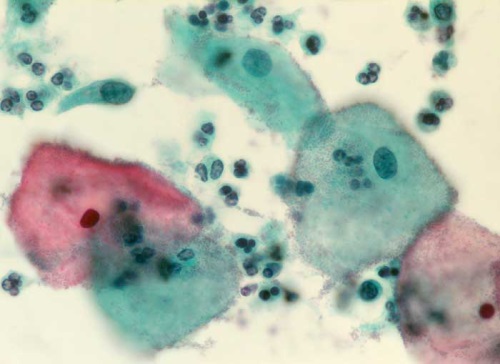
Clue cells - epithelial cells develop a stippled appearance due to being covered with bacteria
Management
- if the woman is asymptomatic, treatment is not usually required
- e.g. picked up on a swab done for different reasons
- exceptions include if a woman is undergoing a termination of pregnancy
- if symptomatic: oral metronidazole for 5-7 days
- 70-80% initial cure rate
- relapse rate > 50% within 3 months
- a single oral dose of metronidazole 2g may be used if adherence may be an issue
- the BNF suggests topical metronidazole or topical clindamycin as alternatives
- if pregnant
- results in an increased risk of preterm labour, low birth weight and chorioamnionitis, late miscarriage
- it was previously taught that oral metronidazole should be avoided in the first trimester and topical clindamycin used instead. Recent guidelines however recommend that oral metronidazole is used throughout pregnancy
- if asymptomatic: discuss with the woman's obstetrician if treatment is indicated
- if symptomatic: either oral metronidazole for 5-7 days or topical treatment. The higher, stat dose of metronidazole mentioned above is not recommended

Comparison of bacterial vaginosis and Trichomonas vaginalis © Image used on license from PathoPic